








When a Familiar Tool Needs a New Perspective
An electric screwdriver is a familiar part of everyday life, from assembling furniture to making small repairs around the house. But when screws are tucked inside cabinets, close to side panels, or in narrow corners, reaching them can still be surprisingly difficult. The usual workaround is to adjust your grip, switch tools, or find an extra attachment.
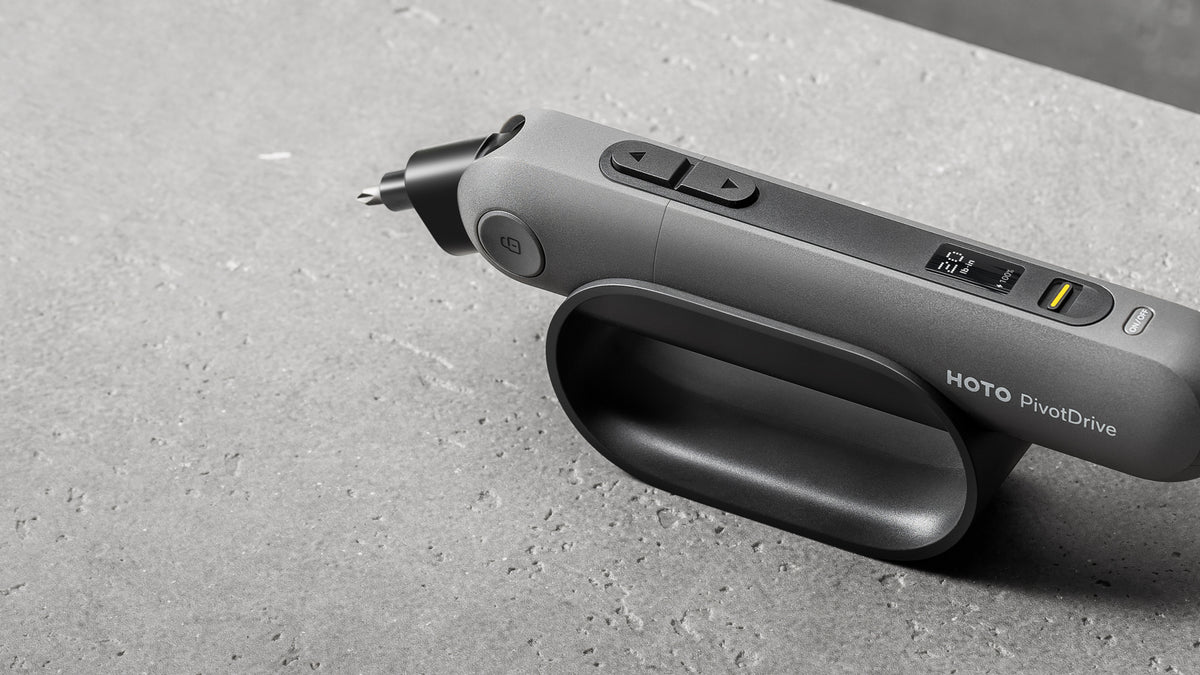
HOTO PivotDrive Cordless Screwdriver takes a different approach. Its folding head adjusts up to 90°, allowing it to work in spaces as narrow as approximately 8 cm. Its off-axis drive system brings the bit axis as close as 9 mm to an adjacent wall, making it easier to reach screws in tight clearances.
These capabilities come from two fundamental design changes: rethinking the screwdriver's working angle and repositioning its output shaft.
Short-Folding Head: Rethinking the Tool's Form
One design challenge was how to adjust the screwdriver's working angle without making the tool bulkier.
A traditional straight-handle screwdriver has a fixed working angle, limiting its ability to reach screws in confined spaces. PivotDrive addresses this with a folding head that locks into four positions: 0°, 30°, 60°, and 90°.
To combine this flexibility with a more compact form, HOTO's design team significantly reduced the length of the folding-head section. This allows PivotDrive to work in spaces as narrow as approximately 8 cm, even with its head folded to 90°, making it easier to reach tight corners.

Off-Axis Drive System: Rethinking the Output Position
Another design challenge was the position of the output shaft itself. In a conventional screwdriver, the shaft sits at the center of the tool. When working close to a cabinet side panel or inside a corner, the tool body can hit the surrounding surface before the bit is properly aligned with the screw.
HOTO's design team reengineered the internal gear arrangement to redirect rotational movement, shifting the output shaft closer to the edge of the tool. This brings the bit axis to just 9 mm from an adjacent wall, reducing interference when working in tight clearances.


The redesigned transmission also had to fit inside PivotDrive's compact folding head, which allows the tool to work in spaces as narrow as 8 cm. Despite the limited room, the team integrated six ball bearings and four precision-machined rotating shafts alongside the redesigned gears. Working together, these components support smooth rotation and reliable torque transmission, ensuring stable power delivery despite the offset output position.

To validate the reliability of this compact mechanism, the team began with computer simulations under static loads to assess the structural integrity of the design. However, simulations alone could not fully capture the sudden impacts and changing forces encountered during actual operation. The team therefore refined the mechanism through more than 10 rounds of physical prototyping, followed by 200 bidirectional impact tests at 8 N·m to evaluate structural integrity under sudden loads and nearly 10,000 tightening and loosening cycles to assess durability. Together, these tests helped ensure consistent torque delivery and reliable performance over repeated use.
More Access, Without Compromising Performance
With an adjustable working angle and an off-axis output position, PivotDrive makes hard-to-reach fastening tasks more accessible without compromising the performance expected of a screwdriver.
For HOTO, this is what industrial design is about. A familiar tool doesn't need more features for the sake of innovation. It needs a better understanding of how people use it, and thoughtful engineering that turns those insights into practical improvements. PivotDrive reflects HOTO's belief that even the most familiar tools can be taken further, not by adding more features, but by rethinking what they can do.


Author: HOTO Branding Team


