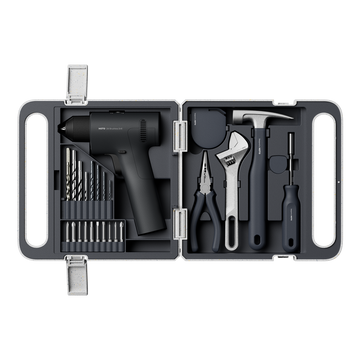








At first glance, a screwdriver, a drill, and a rotary tool can seem surprisingly similar. They all spin. They all use attachments. And in product photos, they can all look like compact handheld tools meant for DIY.
But these tools are not different versions of the same thing. They are built on different working principles.

The easiest way to understand them is to look at torque and speed.
Torque is twisting force. It tells you how strongly a tool can keep turning when it meets resistance.
Speed, usually measured in RPM, is how fast the bit spins.
-
A screwdriver is designed to control torque for fastening screws precisely
-
A drill combines higher torque with higher speed, allowing it to push through materials
-
A rotary tool relies on very high speed with low torque, using rapid rotation to grind, cut, and polish surfaces
That is the real difference. A tool can spin fast and still be bad at driving screws. A tool can have strong torque and still be the wrong choice for polishing.
When to Use a Screwdriver
A screwdriver is designed for one main job: driving screws in and out with control.
That means the tool needs enough torque to tighten a screw securely, but not so much that it strips the screw head, cracks plastic, or damages wood. That is why controlled torque matters so much more here than raw speed.
It feels right for:
-
assembling furniture
-
tightening hinges
-
installing handles
-
fixing loose hardware
-
opening and re-fastening household items

This is also why a product like HOTO PixelDrive fits so naturally into beginner home use. It offers six torque settings from 0.5 to 6 N·m and two speed options, 80 RPM and 200 RPM, which makes it much easier to stay in a safe, usable range for common household fastening instead of jumping straight to drill-level power.
Shop HOTO PixelDrive Cordless Screwdriver →
When to Use a Drill
A drill is not just a stronger screwdriver.
Its core job is different: it is built to push through material. That means it needs more power, more torque, and usually much higher speed than a screwdriver.
For example, HOTO 16V Brushless Drill is rated up to 50 N·m torque with 400 / 1700 RPM speed modes, which is in a completely different class from PixelDrive’s 0.5–6 N·m and 80 / 200 RPM.
That difference explains the real distinction: a screwdriver helps a screw go in cleanly while a drill helps a bit cut into material and create a hole.

That is why a drill feels right for:
-
drilling into wood
-
drilling pilot holes
-
installing anchors
-
mounting shelves
-
working with thicker boards or walls
Sometimes, drills can also drive screws. But because they are built with much more force, they are easier to overdo. Especially for beginners and especially on small screws, plastic parts, thinner boards, and finished surfaces.
When to Use a Rotary Tool
A rotary tool confuses beginners the most because it also spins, but it works on a completely different principle.
A rotary tool is not mainly about torque. It is mainly about very high RPM.
HOTO’s 12V Cordless Rotary Tool runs at 5,000 to 35,000 RPM, far beyond the RPM range of a screwdriver or drill in normal fastening use.

It is good at:
-
polishing
-
sanding
-
grinding
-
carving
-
cutting small parts
-
refining edges
It does not “push” like a drill or “tighten” like a screwdriver. Instead, it removes material by fast, repeated surface contact.
So if the task is about surface finishing, shaping, or detail work, a rotary tool makes sense.

Explore HOTO 12V Cordless Rotary Tool →
The confusing situations beginners ask about most
These are the scenarios where people hesitate, because the job sounds like it could fit more than one tool.
I’m putting furniture together and there are lots of screws
Use a screwdriver, not a drill, in most cases.
Why people get confused: a drill feels faster and stronger.
But furniture assembly is usually about repeated fastening with moderate resistance, not hole-making. Too much force can strip the screw or damage the board. A torque-controlled screwdriver like PixelDrive is usually the cleaner choice here.

I need to mount something on the wall
Usually start with a drill, then switch to a screwdriver.
Why people get confused: both tools can work with screws.
But wall mounting often has two separate steps: making the hole, then fastening the screw. The drill handles the hole. The screwdriver gives more control for the final tightening.
I need to drive one big screw into wood
This is the gray zone.
If the resistance is still moderate and the screw is within the tool’s capacity, a higher-torque screwdriver may be enough. HOTO PixelDrive goes up to 6 N·m, which covers a range of home fastening tasks. But once the material becomes denser or the screw becomes more demanding, a drill becomes the safer choice because it is built for much higher torque output.
I need a cleaner finish after cutting or drilling
Use a rotary tool after the drill or screwdriver.
Why people get confused: they think the first tool should do the whole job.
In reality, many DIY tasks have stages. Drill for the hole, screwdriver for fastening, rotary tool for the finish. These tools often work better as a sequence than as substitutes for one another.

I need to make a small hole, so can I just use a screwdriver
No, this is where you need a drill.
Why people get confused: the hole is small, so the task feels “light.”
But the real issue is not size. It is function. A screwdriver is not designed to cut a hole into material, even if the hole is small.
FAQ
-
Is a screwdriver or drill better for furniture assembly?
A torque-controlled screwdriver is usually better because it offers more control and reduces the risk of over-tightening. Tools like the PixelDrive, with adjustable torque levels, are designed for this type of task. -
Can one tool handle most everyday home repairs?
For most fastening tasks, yes. A cordless screwdriver with adjustable torque can cover common repairs without the extra power of a drill. -
When should I use a drill instead of a screwdriver?
Use a drill when you need to make holes or work with dense materials that require more force.

Author: Chirmie